David Wallace-Wells voiced some concerns about data center activism earlier this month, in a column titled “Data Centers Are a Distraction. The Real Fight Is Elsewhere.” Wallace-Wells writes:
“I don’t know how [fighting data center siting] will address fears that a small group of tech oligarchs are working feverishly to design a future in which many of the rest of us might be rendered functionally obsolete."
It’s a fine question to ask. If you asked me to make a list of my concerns about the AI future, the excessive energy use from data centers would be on the list, but it wouldn’t rank among the top ten. Local fights against data center contracts are an imperfect vessel for the much broader AI backlash.
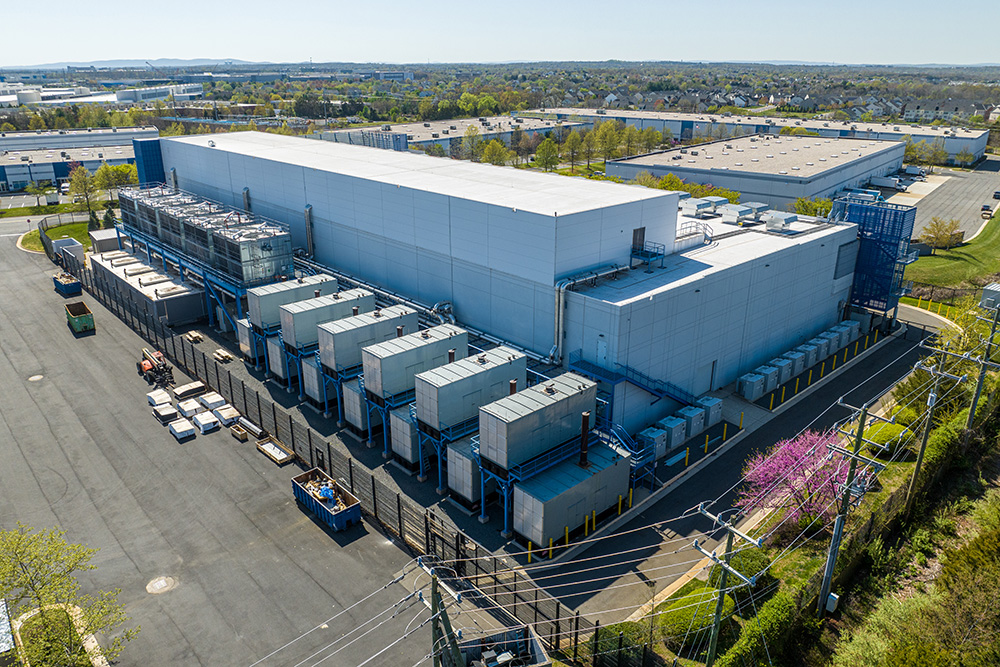
Loudoun County Data Center, photo by Hugh Kelly, PEC.
But there is also, I think, a compelling answer to his question. Data center activism is a bankshot. It can trigger a reset of the status quo, and has the potential to make a lasting impact on the digital future.
Let me provide a bit of scaffolding first: There are a few claims that I routinely make about digital futures’ past that really apply to the current AI bubble:1
(1) The arc of any emerging technology bends toward money. We can have a better or worse digital future, depending on who sets (and who enforces) the rules. Giving the tech oligarchs free rein to pursue easy profit is a surefire way to end up in living in a dystopia. (extended argument here, from 2022)
(2) The essential thing to understand about tech futurism is that, when one of Sam Altman or Elon Musk’s predictions doesn’t pan out, they don’t have to give the money back. (extended argument here, from 2025)
(3) We’re in an AI bubble right now. How and when that bubble pops will dictate a whole hell of a lot about what happens next. (extended argument here, from 2025)
The single best thing that could happen to the AI industry right now is for the current finance bubble to pop. The sooner the bubble pops, the better. This is both because smaller finance bubbles are less calamitous than larger finance bubbles (replaying the 2000 dotcom crash is better than replaying the 2008 great financial crisis) and because, right now, Sam and Elon and Dario and Alex Karp and Marc Andreessen are calling all the shots. After the crash, their power will be constrained and contested. Decreasing their political power is just a fantastically pro-social outcome.
The trouble is that finance bubbles aren’t easy to pop. As Keynes supposedly once remarked, “the market can remain irrational larger than you can remain solvent.”
The standard approach is to loudly declare, with clear and compelling evidence, that the market has dramatically overestimated the value of a company (or a cluster of companies, in this case). That’s what triggered Enron’s downfall: a Wall Street Journal reporter raised the alarm, then Jim Chanos shorted the company and started making a public stink about their financial flimflam. The house of cards collapsed soon after.
That approach doesn’t seem to be working here. The Wall Street Journal keeps reporting on circular financing. Ed Zitron keeps shouting that the math doesn’t math. But media is so fragmented, the regulatory state so compromised, and wealth so concentrated that the investor-class just keeps pumping money in. The endgame seems to be that the AI industry achieves too-big-to-fail status, and that the major players can demand a bailout once the whole thing implodes. (That would be, y’know, really really bad. But it also seems awfully plausible, given the state of elite politics in 2026.)
Silicon Valley runs on futurity. The metaverse felt like the future for a couple years. So long as the metaverse had the aura of futurity, investor dollars flowed. Then the whole thing faltered and fell apart. The same thing happened to Web3 and a lot of other speculative technological futures. The AI industry knows this. It’s why the major players are constantly announcing new not-yet-half-baked products (quick, someone explain why the Jony Ive/Sam Altman partnership was newsworthy at the time) and constantly releasing manifestos. They need us to believe not just that AI is useful, but that it is inevitable, arriving fast, and bringing about a radically different world. That’s the only way to keep the cash-furnace stoked. The steady flow of investor cash only keeps going so long as they maintain a steady cadence of product demos, benchmark successes, and confident futurism.
Slow the pace down, and you lose the aura of futurity. And then the whole house of cards collapses.
Local opposition to data centers creates a ton of friction for the AI industry. They were not expecting this, and they don’t seem to know how to handle it. It’s a good leverage point for fighting the broader AI industry.
People really hate the AI future right now. And people have no place to put that hatred. They see it coming. They see Sam Altman and Elon Musk and Dario Amodei being smug assholes, promising that no one will have a job and only a few dozen people will have any money and teehee maybe it will end the world but probably not and anyway you better let them do whatever they want because otherwise China will do it first and where is your patriotism anyway?
And they see that this handful of shitty dudes has all the money and all the power and AI is getting stuffed into every product and some of it is kind of cool, though a lot of it is annoying, but it isn’t as though anyone can do anything about it.
I heard this from my students all semester. They use AI, and they hate AI. This stuff is the future, and it’s a bad future, and they’re just kind of stuck with it.
Data Centers aren’t the perfect vehicle for all those sentiments. But they are a perfectly functional vehicle. David Sacks (or whoever replaces him as AI Czar) isn’t going to listen to you, because David Sacks (and that whole odious crowd) doesn’t care about democracy to begin with. And your member of Congress probably isn’t going to listen to you, because they’re worried about facing an avalanche of AI political spending in 2026. Also, even if they did, lol Congress doesn’t pass laws anymore, and any worthwhile law they did somehow pass would be vetoed by Trump or overturned by the Court.
But your state and local reps really might listen to you. AI isn’t primarily a zoning issue, but treating it as a zoning issue is one of the few ways to voice productive, collective dissent.
(It’s a bit like how copyright law became a multitool for stopping online harms. If someone posts deepfake porn of you on a social media platform, you are much more likely to get it taken down by saying “hey! copyright violation!” than by saying “are you fucking kidding me? I have rights. I am being harassed in the grossest possible ways. Your terms of service forbid this shit. Do something goddammit!” It isn’t a good sign that copyright is the only functional lever. But it is a lever nonetheless.)
People are driven to fight these data centers for a lot of reasons — energy bills, civic power, rage at the empty, anti-human imagined future that is being foisted upon us all. They’re all good reasons. This is how social movements get to work.
The original Luddites didn’t break machines because they liked breaking machines. They didn’t break machines because they were reflexively anti-technology either. (Read Brian Merchant, y’all) They broke machines because other forms of legitimate resistance were illegal or ineffective. Social movements gravitate toward whatever tools are available.
Local resistance to data centers is the best tool available right now. And the more I think about it, the more convinced I am that it’s a very good tool indeed. It has the potential to slow down the cadence of futurity, pop the finance bubble, and reset the entire public debate over how artificial intelligence is built, deployed, and regulated.
Data center activism is a bankshot. That’s what David Wallace-Wells doesn’t see. It’s what we all ought to recognize. There’s an opportunity here, and it’s a good one: The local fights create friction for industrial deployment. The friction slows down the cadence. Slowing down the cadence makes it impossible to sustain the bubble. And after the bubble pops, we gain much more agency to shape the trajectory of the digital future.
This is how we win.
1 You’ll find these claims in my forthcoming book, Vaporware, Inc: How Silicon Valley Sells the Future to Control the Present. Longtime readers of this blog/newsletter will also recognize them as stuff-Dave-says-all-the-time.