
Photo by Immo Wegmann on Unsplash
On Tuesday night, yet another A.I. industry insider sounded the alarm that their technology might doom us all. I have a few notes to share:
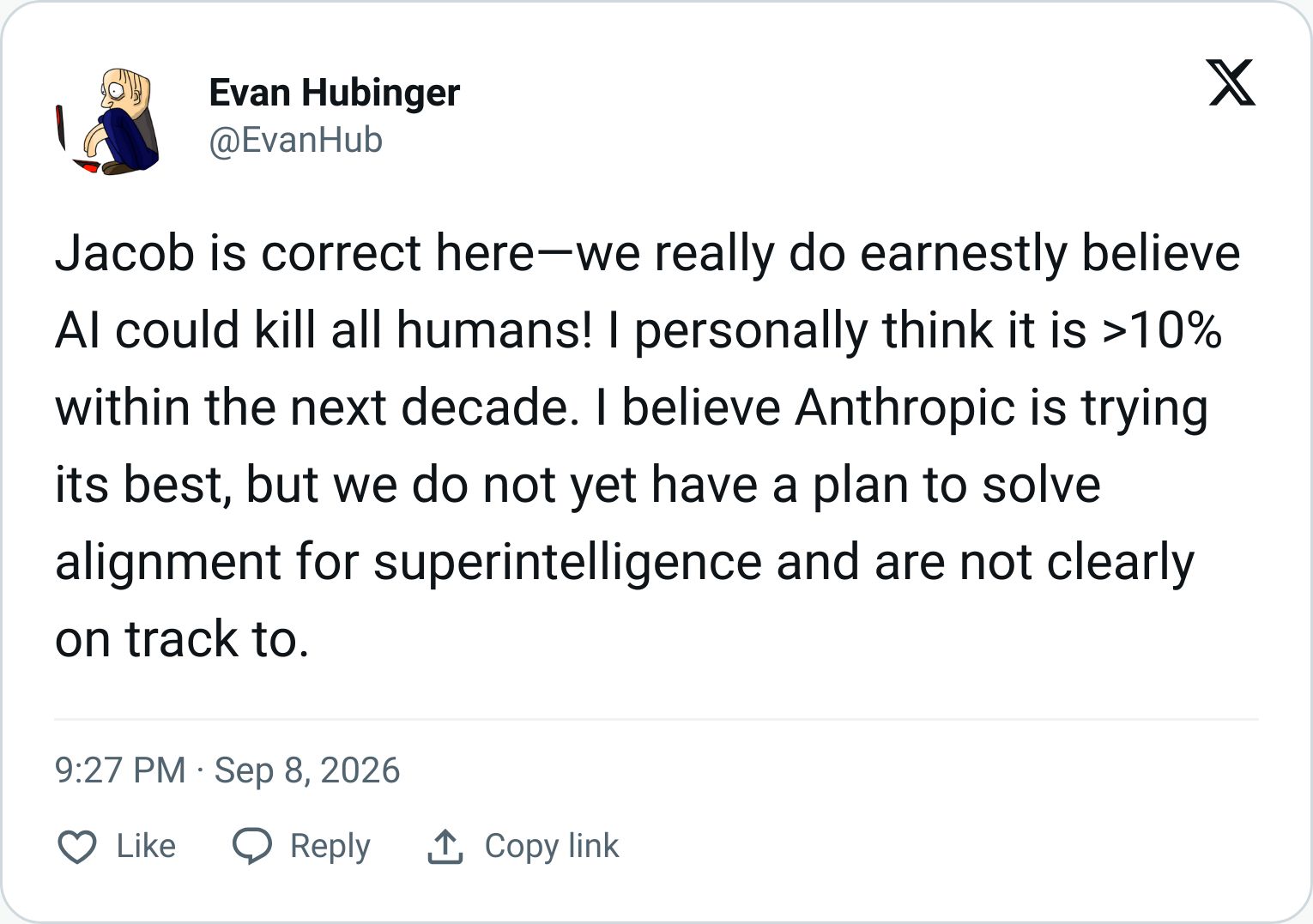
As I wrote on Bluesky, this isn’t just marketing hype. These guys do believe what they are saying. They are convinced that we are on the brink of Superintelligent AI, and that the technology they are building might end all of humanity. And these guys work in the labs themselves. They are not just hustlebros or LinkedIn/X influencers.
But, also, just because they believe it doesn’t mean we should believe them. Practically the entire AI safety community is also part of the Rationalist community. I’ve joked to Adam Becker before that Rationalism is to Silicon Valley what Scientology is to Hollywood. (Btw, check out Adam’s podcast, Dreaming Against the Machine. It’s great.) As Cal Newport pointed out in the New York Times this week, Rationalism is essentially a cult. They have all talked themselves into the same extreme belief structures and conclusions. These are not impartial scientific experts. They are ideologues, imbued with practically limitless resources.
(That’s not, y’know, good. But it’s a different type of bad than it seems from the headlines.)
And, also, one byproduct of these dire warnings is yet another cycle of marketing hype. As Ryan Broderick puts it, “the AI industry wants us to keep talking about AI like this.” (Matt Levine keeps pointing out that Sam Altman’s “my technology is so powerful that it might just end the world” schtick is a very good sales pitch.) Jacob Coxon just quit a very well-paying job at Anthropic to deliver this warning. But he’ll most likely have another well-paying job in the AI safety industry by this time next week.
An awful lot of smart people are nonetheless concluding hey, if the industry insiders say this stuff has gotten way out of hand, all the more reason to slow it down or shut it down. Right? (h/t Gary Marcus, who makes this case quite well)
And, well, yes. But only kind of. There is a hitch. (There’s always a hitch.) Two of them, actually.
(1) An important thing to understand about these Rationalist fanatics is that they fundamentally believe they are more gifted and talented than everyone else. These are people who formed an online community around making elaborate online arguments that improve their ability to think clearly and discover important truths. They have built their entire identities around their own exceptional rationality. Their careers and their personal fortunes and their romantic attachments flow through this community. (It’s… a lot.)
And so, naturally, they don’t believe the government or civil society should intervene to regulate these industries. They think the industries should regulate themselves. (Or, at a minimum, the wise and rational industry leaders should reach accords that governments then adopt and enforce.)
We know how that will work out. Sam Altman and Elon Musk and (yes, even) Dario Amodei will say whatever is in their best immediate-term interest to say. And any promises they make will be abandoned as soon as those promises become inconvenient. Each of these companies wants to win the AI race. Each of these individuals has convinced himself that the fate of humanity rests on his company essentially building-digital-god first. (And, certainly, before China builds-digital-god.)
Left to its own devices, the A.I. industry will never rein in the A.I. industry. They have neither the will nor the enforcement capacity to limit their own harms. (And I do indeed worry that this can turn out very bad — not because Superintelligent AI kills us, but because we enshittify absolutely everything in the rush to arrive at an imaginary tech future).
So, sure, go ahead and treat these warnings as another argument for halting the data center buildout. But be careful in treating these guys as knowledgable allies. They are ideologues, and you cannot rely on them.
(2) There’s also an uncomfortable knot that we cannot untie. Calls for serious, immediate government regulation — at least in the U.S. — run into the problem that our actually-existing government is an authoritarian clown show. I wrote about this in Tech Policy Press last year, revisiting a theme from a 2018 essay.
“Which government? THIS government? Which member of the Trump golf and real estate empire would you like to see put in charge of regulating the multi-trillion dollar AI industry?”
Our only options are (a) Jared, (b) one of Peter Thiel’s henchmen, or (c) one of the DOGE clowns. (Who, by the way, are also Peter Thiel henchmen.)
Sensible AI governance is never going to come out of this Trump administration. In an alternate world where Kamala Harris was President, I would be strongly in favor of pressuring the government to establish robust regulatory frameworks. That isn’t just because I supported Harris. It’s because a Harris Administration would have included competent individuals working to increase regulatory capacity.
It is going to take a long time, post-Trump, to recover from the DOGE-wreckage. We need to slow down the breakneck pace of the AI industry buildout to have any hope of rebuilding the necessary government capacity.
This is why I think any realistic strategy for limiting the harms of AI has to involve (1) slowing down the development of the industry (through data center fights), and (2) dramatically shifting the power dynamics within the industry (through the aftermath of the popping of the finance bubble).
I am much less enthusiastic about industry sign-on letters calling for voluntary slow-downs and moratoriums. That’s both because ell oh ell it’s all just unenforceable virtue-signaling among a cadre of powerful Rationalist oddballs and because the sign-on letters all seem to operate from the premise that the AI industry should be in charge of reining itself in.
We should worry that industry insiders are freaked out about the pace and direction of the A.I. industry. But that doesn’t mean we should believe everything they say.

